Electric Pizza Ovens That Actually Reach 700°F: Ninja Woodfire, Ninja Artisan, and Current Model P Compared
If you’ve looked into making great pizza at home, you’ve probably run into one recurring problem: standard kitchen ovens top out around 500–550°F (about 260–290°C), and great Neapolitan-style pizza—the kind with a blistered, slightly charred crust that puffs and chars in under two minutes—wants heat closer to 700–900°F (370–480°C). The gap matters because high heat is what creates that leopard-spotted crust fast, before the toppings overcook. Dedicated pizza ovens, whether wood-fired or gas, solve this with intense, focused heat. Until recently, electric versions couldn’t get close. That’s changed. A new crop of countertop and outdoor electric pizza ovens now advertises 700°F ceilings, which puts them in genuinely useful territory. This article compares three of the most-discussed options right now—the Ninja Woodfire, the Ninja Artisan, and the Current Model P—on specs, owner-reported real-world performance, honest tradeoffs, and price-to-value math. By the end, you’ll have a clear “if this is your situation, buy this one” decision framework.
Why 700°F Is the Threshold That Matters
To understand why these ovens are worth comparing at all, it helps to know what separates a novelty countertop appliance from a real pizza tool. The benchmark in the industry is Neapolitan-style pizza, which the Associazione Verace Pizza Napoletana specifies must be cooked at 800–900°F (430–480°C) for 60–90 seconds. That’s a wood-fired standard most home cooks can’t replicate. But around 650–750°F, you enter a range where a thin-crust pizza can finish in two to three minutes with genuine leopard spotting—not the pale, limp result a home oven produces.
Thermal mass matters here too. That’s the oven’s ability to store heat in its cooking stone or deck and release it into the pizza’s bottom crust, rather than losing it the moment cold dough hits the surface. A stone that’s genuinely saturated at 700°F will give you oven-spring (rapid puff from trapped gases) and crisp the bottom simultaneously. An oven that claims 700°F but reaches it only at the element—not at the stone surface—will still underwhelm.
Coverage of electric pizza ovens in Food & Wine’s electric oven roundup and Apartment Therapy’s countertop oven guides has consistently flagged this divergence as the defining flaw of older-generation electric pizza ovens: element temperature and stone surface temperature diverging by 100°F or more. The three ovens below are worth discussing because published specs and owner-reported patterns suggest they’ve narrowed that gap.
The Three Contenders: Specs at a Glance
| Oven | Max Rated Temp | Power Draw | Primary Use Case | MSRP (May 2026) |
|---|---|---|---|---|
| Ninja Woodfire (OO101) | 700°F | 1,700W | Outdoor / deck | ~$400 |
| Ninja Artisan | 750°F | 1,800W | Indoor countertop | ~$250 |
| Current Model P | 700°F | 1,800W | Indoor / countertop | ~$350 |
MSRPs reflect U.S. retail pricing as of May 2026. Retailer pricing fluctuates; check current availability before purchasing.
Detailed Oven Reviews
Ninja Woodfire (OO101): The Outdoor-First Option
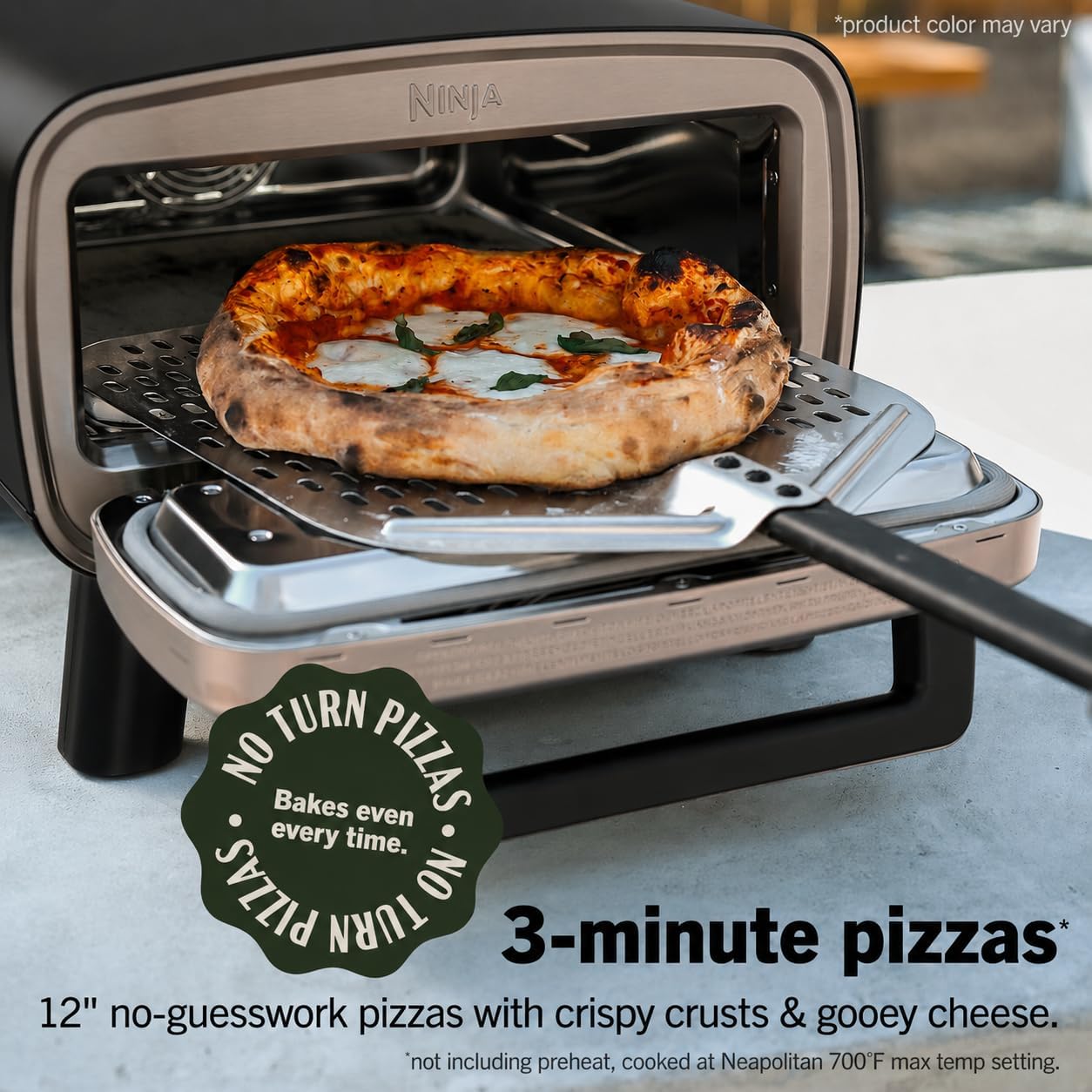
The Ninja Woodfire pizza oven is the outdoor-positioned sibling in Ninja’s lineup. Its headline feature is the integrated pellet smoker tray—a small hopper that accepts food-grade wood pellets to layer smoke flavor on top of electric heat. This is not a wood-fired oven in the traditional sense (wood is not the primary heat source), but the smoke integration is real and owners consistently report a detectable difference in flavor compared to purely resistive-electric cooking.
What the specs say: Manufacturer-rated at 700°F, 1,700W draw, designed for 110V outdoor-rated circuits. The cordset is rated for exterior use, which matters if you’re setting this up on a covered patio without a dedicated line nearby.
What owners and reviewers report: Serious Eats, in their guide “The Best Outdoor Pizza Ovens, Tested and Reviewed,” notes that stone surface temperatures—measured with infrared thermometers after a full 20–25 minute preheat—commonly land in the 620–660°F range, somewhat below the rated 700°F ceiling. That’s still functional for high-heat pizza but sets realistic expectations. The pellet integration adds a 5–10 minute startup variable as the pellets catch. Extended-use accounts describe smoke output as “subtle to moderate” rather than dramatic—useful differentiation, not a wood-oven replacement.
The honest tradeoff: You’re paying roughly $150 more than the Artisan for the outdoor rating and the smoke feature. If you genuinely cook outdoors and want smoke complexity, that premium is justifiable. If you’re in a wet climate or a rental where outdoor outlet access is limited, the use case narrows considerably. Wirecutter, in “The Best Pizza Ovens,” positions the Woodfire specifically for patio-first households who want one electric appliance that does double duty for pizza and smoked proteins.
Don’t buy this if: You plan to use it indoors (it’s not designed for enclosed spaces), you live in a rainy region where outdoor cooking windows are limited, or smoke flavor is irrelevant to your pizza style.
Ninja
$299.95
In stock on Amazon
Check price on AmazonNinja Artisan: The Indoor High-Heat Workhorse
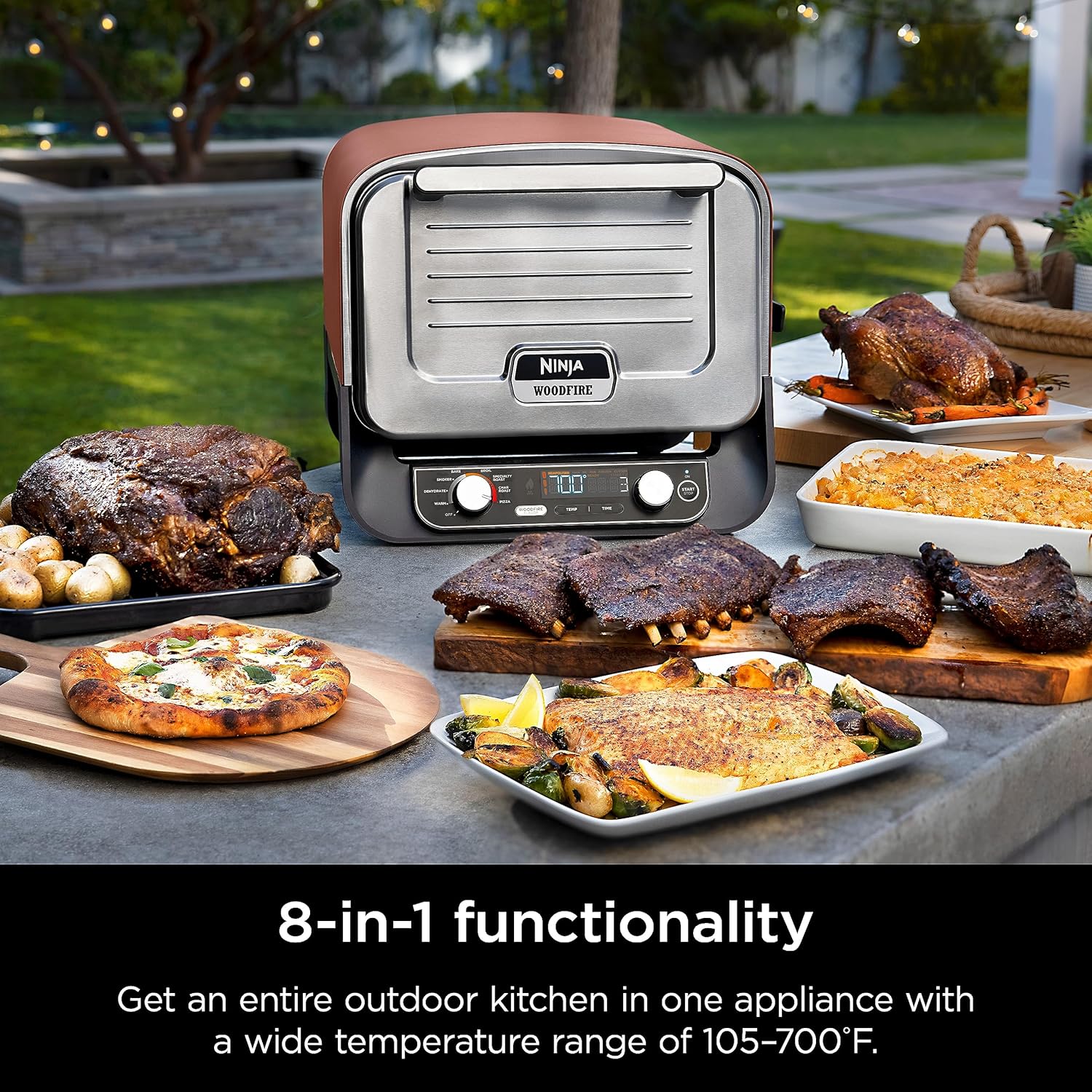
The Ninja Artisan is the indoor-optimized member of the trio, and its 750°F rated ceiling is currently the highest published spec among widely available consumer electric pizza ovens. Bon Appétit, in their piece “We Tried a Bunch of At-Home Pizza Ovens,” flagged it as a legitimate advance over prior-generation countertop units, specifically because of the dual upper-element design that radiates heat from above while the cordierite stone—a dense ceramic material that absorbs and holds heat well—works the bottom crust.
What the specs say: 750°F maximum, 1,800W, standard 110V indoor outlet compatible. The cooking chamber fits up to a 12-inch pizza. Preheat time to operating temperature is manufacturer-cited at approximately 15 minutes, though owner reports suggest 18–22 minutes for full stone saturation.
What owners and reviewers report: The pattern across aggregated reviews is consistent: owners get genuine leopard spotting at 2–3 minute cook times on thin-crust pies when they allow a full 20-minute preheat. New York-style thin crust is frequently cited as the Artisan’s sweet spot. Neapolitan-style pies are achievable but require careful hydration management—wetter doughs tend to steam rather than blister at these temperatures. Food & Wine’s electric oven roundup notes that the Artisan’s upper element proximity creates uneven browning risk if the pizza isn’t centered and rotated at the 60-second mark.
The math: At ~$250 MSRP, the Artisan sits at a per-pizza cost-efficiency point that’s hard to argue with. If you’re making pizza two or three times a week, the appliance pays for itself in avoided restaurant spending within a few months for most households.
Don’t buy this if: You want outdoor capability, smoke flavor, or a cooking surface that accommodates 13-inch-plus pies. The 12-inch limit is a genuine constraint for households feeding four or more people.
Ninja
$299.99
In stock on Amazon
Check price on AmazonCurrent Model P: The Precision Play
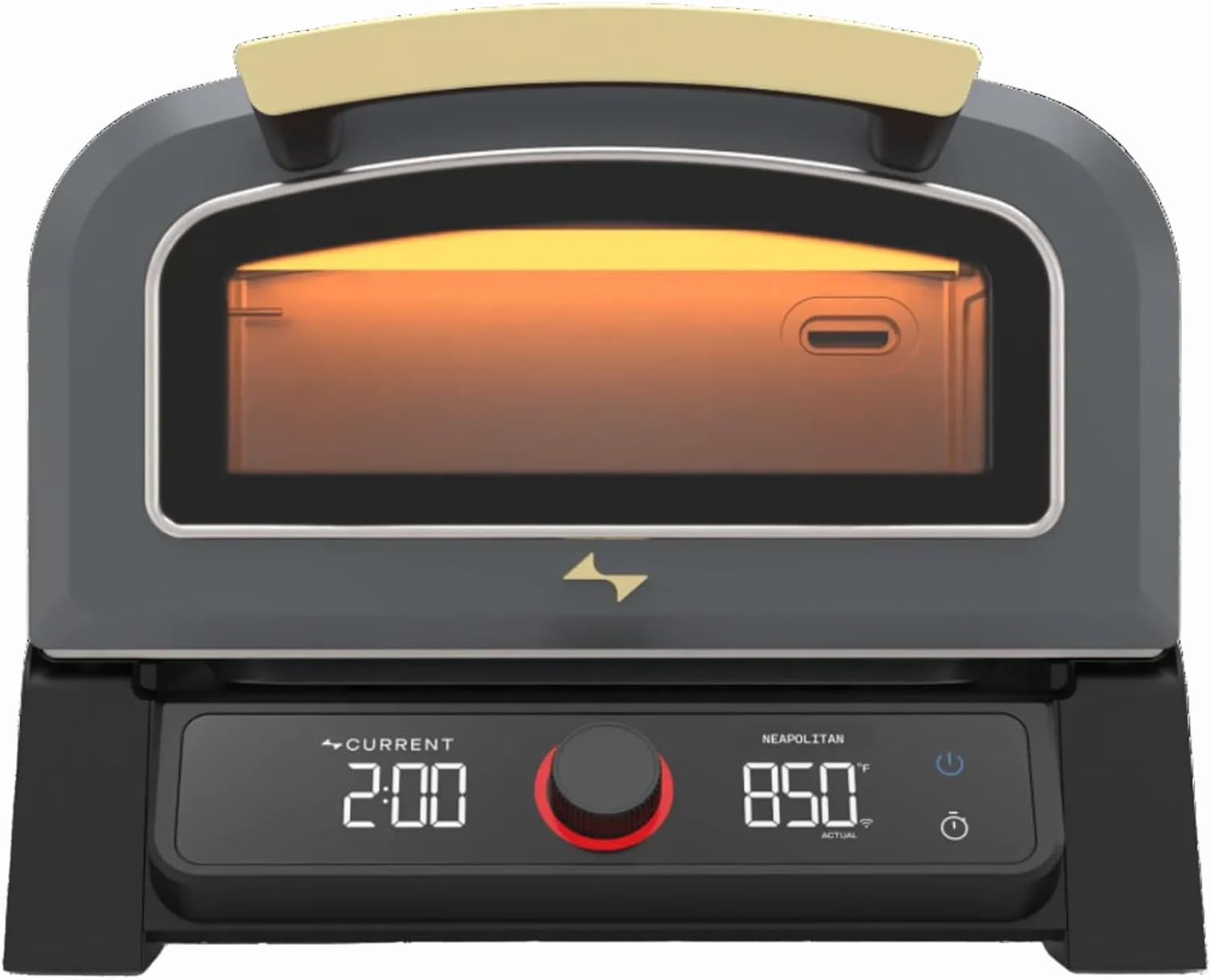
The Current Model P is the newest entrant and the least-established in terms of long-run owner data. Manufacturer-rated at 700°F, 1,800W, and designed primarily for countertop indoor use, it offers a slightly larger cooking deck than the Artisan—accommodating up to 13-inch pies per published specs.
What distinguishes the Model P in spec-sheet comparisons is its dual-zone heating architecture: the upper and lower elements can be adjusted independently via a digital controller, allowing users to bias heat toward the top (for faster char on toppings) or toward the bottom (for crispier crusts on higher-hydration doughs). This is a meaningful design difference from the Ninja ovens, which use simpler single-temperature targeting.
What owners and early reviewers report: Because the Model P is a 2025–2026 release, aggregated long-run data is thinner than for either Ninja model. Apartment Therapy’s early coverage, in their guide “Electric Pizza Ovens That Work Indoors,” describes the dual-zone control as “genuinely useful once you’ve dialed in your dough,” noting that the learning curve is real—owners who try to use it like a single-setting appliance report inconsistent results in the first few sessions. For practitioners who already understand dough hydration, fermentation schedules, and launch technique, the additional control is an asset. For beginners, it’s complexity that may frustrate before it rewards.
The honest tradeoff: The Model P costs roughly $100 more than the Artisan for the larger deck and zone control. If you’re regularly cooking 13-inch pies or experimenting with different dough styles—Sicilian, Detroit, high-hydration sourdough—that premium is defensible. If you’re primarily making standard thin-crust 12-inch pies and want repeatable results without a calibration period, the Artisan is a simpler path to consistent output.
Don’t buy this if: You want a proven, long-run track record before committing. With under 18 months of widespread owner data as of May 2026, the Model P’s durability picture isn’t complete. Heating element longevity in high-cycle-rate home ovens is typically where early adopter risk concentrates.
Current®
$593.85
In stock on Amazon
Check price on AmazonThe Decision Framework
Here’s the honest “if X, then Y” breakdown:
If your primary use case is outdoor cooking on a patio and you want smoke flavor integration: Buy the Ninja Woodfire. Accept the stone surface temperature discount from rated spec, build in a full 25-minute preheat, and invest in quality wood pellets. It’s the only one of the three designed for this environment.
If you want the highest-rated max temperature, indoor operation, a proven owner track record, and a clean price-to-performance ratio at 12 inches: The Ninja Artisan is the straightforward pick. Wirecutter’s “The Best Pizza Ovens” and Serious Eats’ “The Best Outdoor Pizza Ovens, Tested and Reviewed” consistently position it as the benchmark for its category. Rotate your pizza at the one-minute mark and allow a full 20-minute preheat; the results owners report are reliably good.
If you’re an experienced pizza maker already comfortable adjusting variables like dough hydration and bake time, you cook pies 13 inches or larger, and you’re willing to spend a calibration period dialing in zone settings: The Current Model P offers the most control ceiling of the three. It’s the practitioner’s tool, not the beginner’s appliance, and it rewards the investment in proportion to the skill you bring to the deck.
A note on solar and off-grid relevance: All three ovens draw 1,700–1,800W continuously during operation. For off-grid solar setups, that load profile requires serious battery capacity and an inverter rated for sustained high-draw appliances—not a casual addition to a standard home solar array. If solar-powered pizza cooking is your goal, wood-fired and gas options remain more practical for off-grid contexts; these electric ovens are grid-tied tools best suited to grid-connected outdoor kitchens or indoor use.
The 700°F ceiling is real, the category has matured, and the right choice depends almost entirely on where you cook, how large your pies run, and how much calibration effort you’re willing to trade for control. Pick the context that matches your kitchen, not the highest number on the spec sheet.