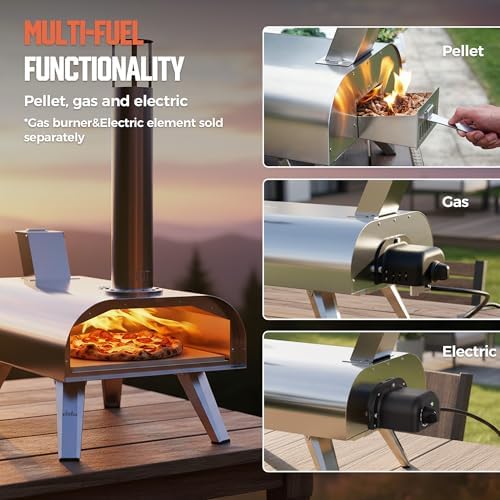
If you’ve been eyeing the outdoor pizza oven category for a while, you already know the pitch: wood-fired flavor, blazing-hot stone, Neapolitan-style pizza in 90 seconds instead of 15 minutes. What the marketing doesn’t always explain is that multi-fuel ovens—models that can run on wood, propane, or wood pellets depending on which burner attachment you connect—give you a meaningful practical advantage over single-fuel designs. On a Tuesday night when you don’t want to babysit a wood fire for 40 minutes, you click in a gas burner and you’re cooking in 20. On a Saturday when you want the smoke and the ritual, you feed it splits and chase 900°F. That flexibility is the whole value proposition of this middle tier.
The three ovens in this comparison—Big Horn, Solo Stove Pi, and Pizzello—all land in the $300–$600 range, all claim multi-fuel capability, and all target the same buyer: someone past the impulse-purchase phase who wants genuine performance without stepping up to a $1,200 Gozney Dome or a full outdoor kitchen build. The differences between them are real, and the right answer depends entirely on what you’re optimizing for. Let’s get into it.
| EDITOR'S PICK[HALO Versa 16 Pizza Oven](https://www.amazon.com/dp/B0B433CV52?tag=greenflower20-20) | 16”… | Mid-tierPIZZELLO 16" Outdoor Pizza Oven… | Budget pickBIG HORN 12" Multi-Fuel Outdoor… | |
|---|---|---|---|
| Fuel types | Propane | Propane + Wood | Wood, Gas, Electric |
| Pizza size | 16" | 16" | 12" |
| Rotating stone | ✓ | — | — |
| Max temp | — | — | 1110℉ |
| Accessories incl. | — | Stone, Peel, Bag | — |
| Material | — | Stainless Steel | — |
| Price | $399.99 | $259.99 | $123.49 |
| See on Amazon → | See on Amazon → | See on Amazon → |
By the Numbers: Quick-Reference Spec Comparison
| Big Horn | Solo Stove Pi | Pizzello | |
|---|---|---|---|
| Street price (May 2026) | ~$350–$420 | ~$479–$529 | ~$280–$360 |
| Max rated temp | 900°F | 950°F | 930°F |
| Cooking surface (stone) | 13” × 13” approx. | 13.5” round | 12” round |
| Weight | ~26 lbs | ~27 lbs | ~23 lbs |
| Multi-fuel options | Wood + propane | Wood + propane | Wood + propane |
| Preheat time (gas) | ~25–30 min | ~15–20 min | ~25–35 min |
Sources: published manufacturer specifications; aggregated retailer listings current as of May 2026.
Heat Performance: Where the Real Differences Emerge
All three ovens are rated above 900°F, which is the threshold you need for a genuine Neapolitan-style pizza—that’s the style with the leopard-spotted char on the crust, achieved by cooking at extremely high heat for a very short time. But rated maximums and real-world cooking temperatures are two different conversations.
Solo Stove Pi: Even Heat, Fast Preheat
The Solo Stove Pi earns the strongest reputation for heat consistency in this tier. Wirecutter’s guide to the best outdoor pizza ovens notes that the Pi’s 360-degree burn design—where the flame wraps around the dome interior rather than blasting from a single back or side port—produces more even heat distribution across the stone than competing designs at the price. Owners report hitting usable cooking temps (700°F+) in 15–20 minutes on gas, which is genuinely faster than the competition. That matters when you’re feeding a group and the window between “kids getting impatient” and “pizza is ready” is everything.
The tradeoff: the Pi’s radiant heat efficiency comes partly from its tighter, more enclosed dome geometry. That same geometry means the cooking mouth—the opening you launch and retrieve pizzas through—is slightly narrower and lower than on the other two. Operators with a 12-inch or larger peel report that the angle of entry requires practice. Serious Eats’ coverage of outdoor pizza ovens notes that peel technique in compact-dome ovens is a legitimate learning curve—not a dealbreaker, but a real factor worth acknowledging before you buy.
PIZZELLO
$259.99
In stock on Amazon
Check price on AmazonBig Horn: Wood-Fire Performance, High-Volume Capacity
Big Horn runs hotter in raw reported peaks under wood, with owners and long-form gear review forums frequently documenting 900°F+ stone temps. It’s a bigger, boxier form factor, and that extra internal volume accepts larger splits of wood more naturally than the Pi’s narrower firebox. If you’re primarily running wood and only occasionally plugging in propane for convenience, Big Horn’s combustion geometry rewards that preference.
The heat distribution is less even than the Pi under gas—left-to-right hot spots are a documented pattern in owner accounts—but the practical fix is straightforward: rotate your pizza every 20–30 seconds, which you should be doing anyway at these temperatures. For batch-cooking six to eight pizzas at a backyard party, Big Horn’s larger cooking surface and wood capacity is the practical winner in this tier.
BIG
$123.49
In stock on Amazon
Check price on AmazonPizzello: Accessible Entry, Honest Ceiling
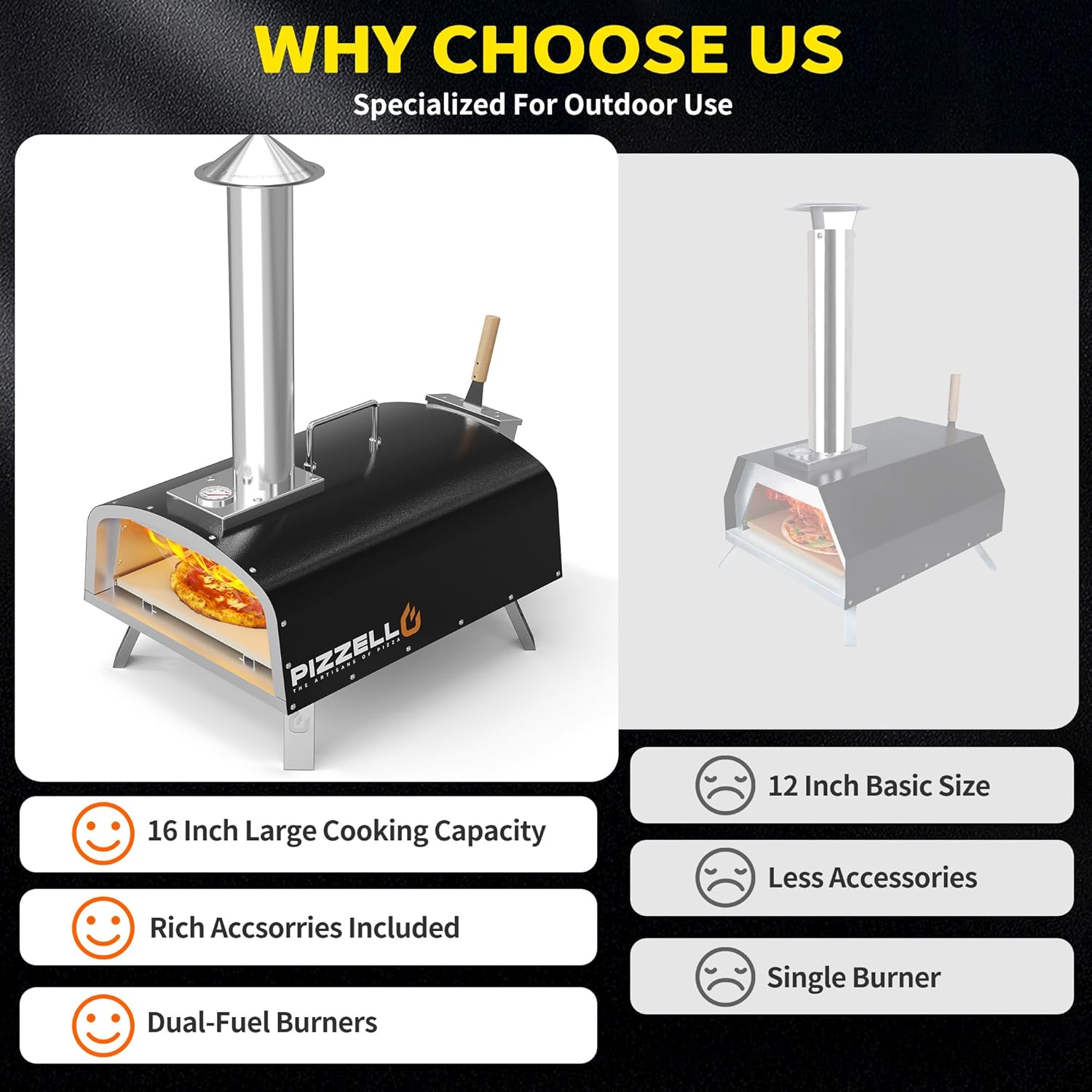
Pizzello is the value entrant, and it performs accordingly. At $280–$360, it’s the most accessible of the three, and owners who use it as a starter oven report genuine satisfaction for household-scale cooking. But preheat times trend longer than advertised, and the cordierite stone—cordierite is a mineral prized for pizza stones because it withstands thermal shock, meaning sudden temperature changes, without cracking—is thinner than the Pi’s. A thinner stone loses heat faster when you load a cold pizza, which shows up as a longer recovery time between pies. For one or two pizzas for a household, that’s fine. For batch-cooking at a party, it starts to matter in ways that are hard to ignore.
Wirecutter’s framework for evaluating outdoor pizza ovens at this price tier treats sub-$350 ovens as learning platforms rather than decade investments—which is the right mental model for Pizzello. Buy it knowing what it is.
BIG
$123.49
In stock on Amazon
Check price on AmazonFuel Flexibility: Is Multi-Fuel Actually Worth It Here?
Multi-fuel isn’t a checkbox—it’s an ecosystem of attachment quality, fuel-switching friction, and how gracefully each oven handles the thermal demands of different combustion sources.
Solo Stove Pi Gas Integration
The Solo Stove Pi’s gas attachment, sold separately under the name “Pi Burner,” is widely reviewed as one of the cleaner integrations in this tier. It slots into the rear of the oven without exposed hardware awkwardness, and the flame distribution is tuned to complement the Pi’s dome geometry. Food & Wine’s pizza oven buying guide has highlighted the Pi as a top recommendation partly on the strength of this fuel-switching convenience and overall execution.
The catch: you’re paying for that integration. The Pi body plus the burner attachment lands at $580–$650 combined, which edges toward the next tier of oven entirely. Buyers who want propane as a genuine equal-status fuel—not just a backup—will find the Pi’s approach worth the premium. Buyers who mostly want wood and occasionally want propane convenience may not need to pay for it.
PIZZELLO
$259.99
In stock on Amazon
Check price on AmazonBig Horn Propane: Functional, Not Refined
Big Horn ships as a complete multi-fuel package at its base price in most configurations, which is a meaningful part of its value story. The propane attachment works, but detailed owner accounts note that it’s more utilitarian than elegant—functional for weeknight convenience, but the flame distribution is less refined than the Pi’s dedicated burner. If you’re a wood-fuel purist who just wants propane as a backup option, Big Horn’s approach is perfectly adequate. If you want propane as a co-equal fuel with a polished cooking experience, the Pi handles it better.
BIG
$123.49
In stock on Amazon
Check price on AmazonPizzello Propane: Mixed Results
Pizzello’s multi-fuel story is the least developed of the three. The propane burner attachment gets mixed reviews—some owners report temperature inconsistencies, particularly at the edges of the stone, that don’t appear as prominently when running wood. It’s the option to choose if budget is the primary constraint and you’re comfortable with the understanding that you’re trading some performance ceiling for accessibility. For buyers focused primarily on wood with occasional propane use, it clears the bar. For buyers who plan to run propane regularly, the gaps in consistency become more relevant over time.
BIG
$123.49
In stock on Amazon
Check price on AmazonBuild Quality, Portability, and the Durability Question
At this price tier, build quality separates ovens that last three seasons from ovens that last a decade. The components that fail first are typically: the cooking stone (cracking from thermal shock or improper drying after rain), the exterior finish (peeling, rust spots on untreated steel), and door or vent hardware (warping, loose tolerances after repeated heat cycles).
Solo Stove Pi: Stainless That Holds Up
Owners of the Solo Stove Pi consistently report solid stainless steel construction with minimal oxidation after multiple seasons of outdoor use. Solo Stove’s brand reputation—built largely on its smokeless fire pit line—is grounded in stainless steel quality, and that DNA carries into the Pi. Bon Appétit’s outdoor cooking coverage positions the Pi as the benchmark for this tier when performance-per-dollar and long-term value are the frame, citing build consistency as a key differentiator.
It’s not cheap stainless. The gauge and finish hold up in long-term owner accounts in a way that sets it apart from the other two options here.
PIZZELLO
$259.99
In stock on Amazon
Check price on AmazonBig Horn: Solid Core, Finish Needs Protection
Big Horn draws a more mixed verdict on longevity. The structural core is solid, but some owners report paint or finish degradation on the exterior after a second or third season of heavy use, particularly when the oven is stored outdoors without a cover. A quality cover—sold separately, typically $30–$50—is essentially mandatory if you plan to leave it outside. With that mitigation in place, durability complaints drop substantially. Budget for the cover when you’re doing the math on total cost.
BIG
$123.49
In stock on Amazon
Check price on AmazonPizzello: Calibrated for the Price
Pizzello at its price point shows the expected compromises: thinner gauge steel, lighter overall construction. It’s not fragile, but it’s built for buyers who either replace gear on a shorter cycle or treat this as a trial purchase before a bigger investment. Serious Eats’ guidance on evaluating outdoor cooking equipment at entry-level price points emphasizes asking whether a product is built to be a long-term tool or a proof-of-concept—Pizzello is the latter, and there’s nothing wrong with that if you go in with clear expectations.
Portability: all three are genuinely portable—one adult can move any of them to a car trunk or patio shelf. The Pi is the most refined in portability terms. Big Horn’s larger form factor is slightly more cumbersome but still manageable. Pizzello is the lightest of the three at approximately 23 lbs.
BIG
$123.49
In stock on Amazon
Check price on AmazonYour Decision Framework
If you’re cooking 2–4 pizzas per session, value gas convenience equally to wood, and are willing to pay for a quality integration — the Solo Stove Pi (plus the Pi Burner) is your oven. The total outlay of approximately $600 is justified by a product that does everything well and holds its value across seasons. Bon Appétit’s outdoor cooking coverage consistently positions it as the benchmark for this tier when the criterion is performance-per-dollar over time.
If you’re feeding groups of 6–10 regularly, primarily want wood as your main fuel with propane as a convenience backup, and want the biggest cooking surface in the category — Big Horn is the right call. Get a cover. Accept that you’ll rotate pies more consciously and that the propane experience is functional rather than refined. At $350–$420 all-in, it’s serious value for high-volume wood cooking.
If your budget caps at $300, you’re new to outdoor pizza ovens, and you want to validate whether this category fits your lifestyle before making a larger commitment — Pizzello is a reasonable starting point. Understand you’re buying a learning platform. If you’re still cooking on it enthusiastically 12 months from now, your next move is a Gozney Dome or Ooni Karu 16, and you’ll know exactly what you want from that investment.
If you live in a region with fewer than 150 sunny cooking days per year—think Pacific Northwest or northern New England—weight the gas and propane experience more heavily in your decision. The Pi’s faster preheat and cleaner multi-fuel execution becomes a bigger advantage when you’re cooking in marginal weather windows and want to get in and out efficiently. In that context, the Pi’s premium is genuinely earned.
One final note for buyers at the top of this tier: the delta between a fully-equipped Solo Stove Pi setup ($600) and an entry-level Gozney Dome or Ooni Karu 16 ($799–$999) is narrower than it looks once you account for accessories, covers, and peels on both sides. If you’re seriously debating between the Pi-plus-accessories and the next tier up, run that math explicitly before you commit. The Pi is excellent. The step above it is meaningfully different in cooking capacity and build quality—and for some buyers, that difference is worth bridging.