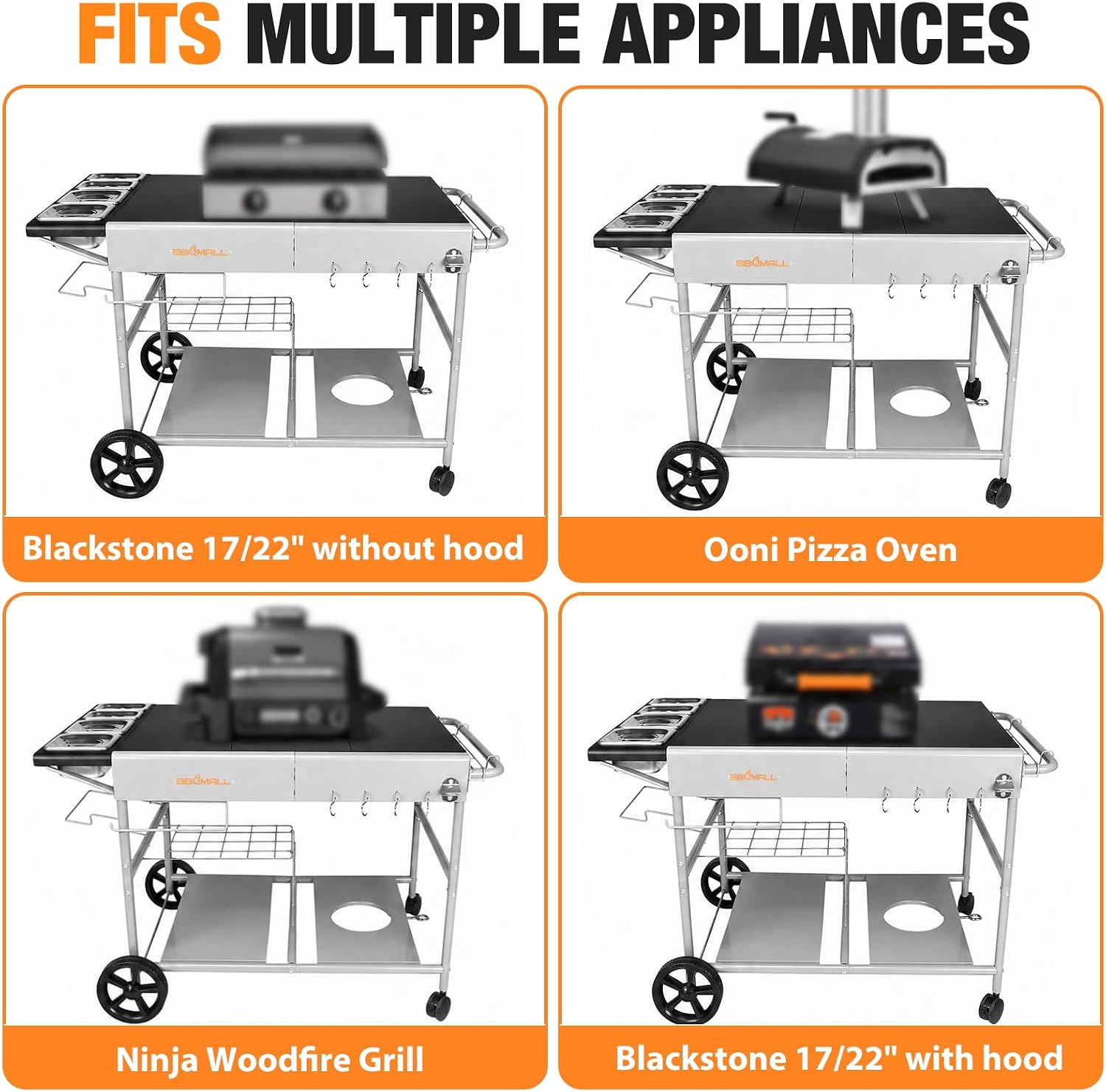
You’ve got the oven. Maybe it’s an Ooni Karu 16, a Gozney Dome, or an Alfa Forni Classico sitting on a patio table that’s two inches too narrow and wobbling every time you reach for the peel (the long-handled paddle you use to slide pizza in and out of the oven). Or maybe you haven’t bought the oven yet, but you’ve realized that a $1,200 piece of equipment deserves more than a folding plastic table and an extension cord running across the lawn. Either way, you’re in the right place. This guide is about everything around the oven — the cart that holds it, the surface where you prep your dough and toppings, and the cover that keeps the whole investment safe between sessions. Get these pieces right, and pizza night stops being a scramble. Get them wrong, and even great dough can’t save the experience.
If you’re at the stage where you have a specific oven under consideration (or already in place), the decisions below are worth treating like a small second project. The math is real, the tradeoffs are honest, and by the end you’ll have a clear decision framework for your situation.
The Cart Question: Purpose-Built vs. Universal vs. DIY
The cart — or stand, or table — is the most consequential peripheral purchase you’ll make, because it determines your working height, your mobility, and how the whole station looks and feels in practice.
Purpose-built manufacturer carts are the obvious starting point. Ooni sells a dedicated cart for the Karu 16 and Koda 16 that locks the oven down with integrated mounting points, holds propane tanks in an enclosed lower shelf, and rolls on casters rated for outdoor surfaces. Gozney makes a similar stand for the Dome. Alfa Forni bundles a stainless steel cart option with several of its freestanding models. The appeal is obvious: fit is guaranteed, the aesthetic is cohesive, and the weight rating is matched to the oven. The tradeoff? Manufacturer carts typically run $200–$400 on top of the oven cost, they’re designed to hold exactly one oven (yours), and if you later switch ovens, the cart becomes a stranded asset.
Universal outdoor kitchen carts — the modular stainless steel prep carts you’ll find from brands like Cuisinart, Napoleon, and Weber — offer more surface area and sometimes better value. A quality 304-grade stainless cart (304 is the industry-standard food-safe stainless alloy, more corrosion-resistant than the cheaper 201 grade) with a folding side shelf, two drawers, and a lower rack typically runs $180–$350. The problem is fit: most pizza ovens sit better at 34–36 inches of working height (matching standard kitchen counter height), but not all universal carts hit that number, and none of them have the mounting security of a purpose-built stand. Owners of heavier ovens like the Alfa Forni 4 Pizze (which tips the scale at roughly 80 lbs) consistently flag stability as a non-negotiable — a cart that rocks under that load is a safety issue, not just an annoyance.
DIY or custom builds are where the premium and artisan-tier buyers tend to land. A concrete block or poured-concrete pedestal, a welded steel frame with a soapstone top, or a custom millwork cabinet with a tile surround can anchor an outdoor pizza station permanently and look like it belongs there. The upfront cost is higher ($500–$2,000+ depending on materials and labor), but the result is a cooking station that doubles as a design feature. Dwell’s coverage of outdoor kitchen design consistently shows these integrated builds outperforming bolt-together solutions in both resale value and lifestyle satisfaction. The obvious caveat: a permanent build commits you to a location. If you rent, or if your outdoor layout is likely to change, this path closes off options.
By the numbers:
| Cart Type | Typical Cost | Stability | Flexibility | Aesthetic |
|---|---|---|---|---|
| Manufacturer-matched | $200–$400 | Excellent | Low | Cohesive |
| Universal stainless | $180–$350 | Good–Fair | High | Generic |
| Custom/permanent build | $500–$2,000+ | Excellent | None | Bespoke |
The Topping Station: Where Workflow Lives or Dies
This is the piece most buyers underestimate. A topping station is just a dedicated prep surface positioned close enough to the oven that you can dress a pizza, slide it onto the peel, and transfer it to the fire in under 60 seconds — which matters because dough sitting on a floured peel absorbs moisture and starts to stick after about 90 seconds, as Serious Eats’ pizza technique coverage has documented extensively.
The minimum viable setup is a dedicated work surface at elbow height with a way to keep toppings cold and accessible. In practice, that means:
Surface material matters more than it looks. Marble and granite are the gold standard for pizza prep — they stay cool naturally (helpful when you’re working with room-temperature dough in summer heat) and nothing sticks to a well-floured stone surface. A 24x18-inch marble pastry board runs $60–$120 and can sit atop any stable surface. If you’re building a permanent station, a poured-concrete or soapstone countertop gives you the same thermal mass (the material’s ability to absorb and hold temperature without swinging) with more durability outdoors.
Cold storage proximity is the real logistics problem. Burrata, fresh mozzarella, cured meats — the ingredients that make a great pizza — need to stay cold until the moment they go on. If your outdoor station is more than 15 steps from your kitchen refrigerator, you’ll lose flow every single session. The fix is either a dedicated outdoor mini-fridge (brands like Danby and Summit make weatherized under-counter units rated for outdoor ambient temperatures, starting around $300–$450) or an insulated prep cooler that sits at counter height. Reviewers on cooking forums consistently report that the outdoor fridge upgrade, more than any oven accessory, changes how the experience actually feels.
Mise en place containers (small prep bowls that hold pre-measured toppings) are cheap but transformational. A set of 12 stainless ramekins runs $25–$40 and lets you pre-portion everything before the oven reaches temperature. Bon Appétit’s outdoor entertaining coverage specifically calls out pre-staged toppings as the single workflow change that makes outdoor pizza feel effortless rather than chaotic.
The tradeoff here is space versus completeness. If your patio is small, a full topping station setup might mean sacrificing seating. In that case, a rolling prep cart that stores under the oven cart and pulls out only during cooking sessions is the right call — it collapses your footprint on non-pizza nights.
Covers, Weather Protection, and the Long Game
A quality pizza oven cover is not optional. It’s insurance — and the math is stark. A heavy-gauge weatherproof cover for an Ooni Karu 16 or Gozney Dome runs $40–$80. UV degradation, moisture infiltration, and bird damage (documented repeatedly in owner forums for uncovered ovens left in place year-round) can compromise the stone baking surface (the cordierite or firebrick floor inside the oven that holds and radiates heat into your pizza base) and the exterior finish within a single season of exposure in humid climates.
What to look for in a cover:
- Material weight: 600D polyester with a PVC backing is the minimum standard for lasting UV and water resistance. 900D is better for year-round outdoor exposure.
- Fit: A generic cover that bunches at the bottom lets water pool. Manufacturer-fitted covers are worth the premium here, typically $15–$30 more than generic equivalents.
- Ventilation: Covers with venting panels prevent moisture from being trapped against the oven body — a common cause of surface corrosion on stainless models, as Wirecutter’s outdoor kitchen gear coverage has noted.
Beyond the oven cover itself, think about the whole station’s weather exposure. If the station is permanent, a pergola or retractable awning changes the game — you can cook in light rain, you dramatically extend the usable outdoor season in climates with shoulder-season weather, and the oven itself stays protected without a cover swap every session. Wirecutter’s outdoor shade structure reviews put quality retractable awnings at $800–$2,500 installed, which sounds steep until you consider that it also covers your seating area and extends the entire outdoor kitchen’s utility across the season.
For renters or those with temporary setups, a compact pop-up canopy ($150–$300 for a quality steel-frame version rated for 35 mph wind) positioned to shade the station addresses the same problem at a fraction of the cost.
Accessory Pairings Worth Adding to the Build
A few peripheral items that experienced operators consistently flag as high-value additions:
Infrared thermometer: An instant-read IR thermometer (around $25–$50) lets you check the stone temperature without opening the oven. The target for Neapolitan-style pizza is 700–850°F on the stone surface. Without this tool, you’re guessing — and guessing wrong in either direction means undercooked dough or a burned bottom. This is the single most recommended accessory in aggregated owner reviews across pizza oven categories.
Pizza peel set (two peels): One perforated aluminum launch peel for transferring raw pizza into the oven; one smaller turning peel for rotating during the cook. Using one peel for both tasks is how dough gets stuck and burns. Serious Eats’ equipment coverage has made this two-peel argument clearly and repeatedly — it’s the right call.
Heat-resistant work mat: A silicone or fiberglass work mat under the prep area protects your cart surface from hot tools, errant ember fallout, and the inevitable tomato sauce spill. $20–$40 and entirely worth it.
The “If X, Then Y” Decision Framework
Here’s where the research lands, in plain terms:
- If you have a high-end oven ($800+) and a permanent outdoor space: Invest in a custom or built-in station and don’t cut corners on the cart. The oven will outlast two or three cheap cart solutions — spend the money once.
- If you’re renting or your setup is likely to move: Prioritize the manufacturer-matched cart for safety and stability, pair it with a rolling prep cart, and skip the permanent build.
- If your biggest frustration is workflow during cooking: The topping station and cold storage proximity fix is your highest-leverage spend — more than any oven accessory.
- If you’re building for commercial or glamping use: A permanent covered station with an outdoor-rated refrigerator and weatherproof storage is the only configuration that holds up to repetitive use and guest expectations. The cost-per-session math at 30+ pizza nights per season strongly favors the full build over piecemeal additions.
- If you live in a high-humidity coastal or rainy climate (Pacific Northwest, Gulf Coast, Southeast): A quality weatherproof cover and ventilated storage are non-negotiable. Dwell’s reporting on outdoor kitchen maintenance in coastal climates consistently identifies uncovered equipment as the fastest path to a ruined investment.
The station is the multiplier on the oven. The oven cooks the pizza — the station determines whether doing it is a pleasure or a production.