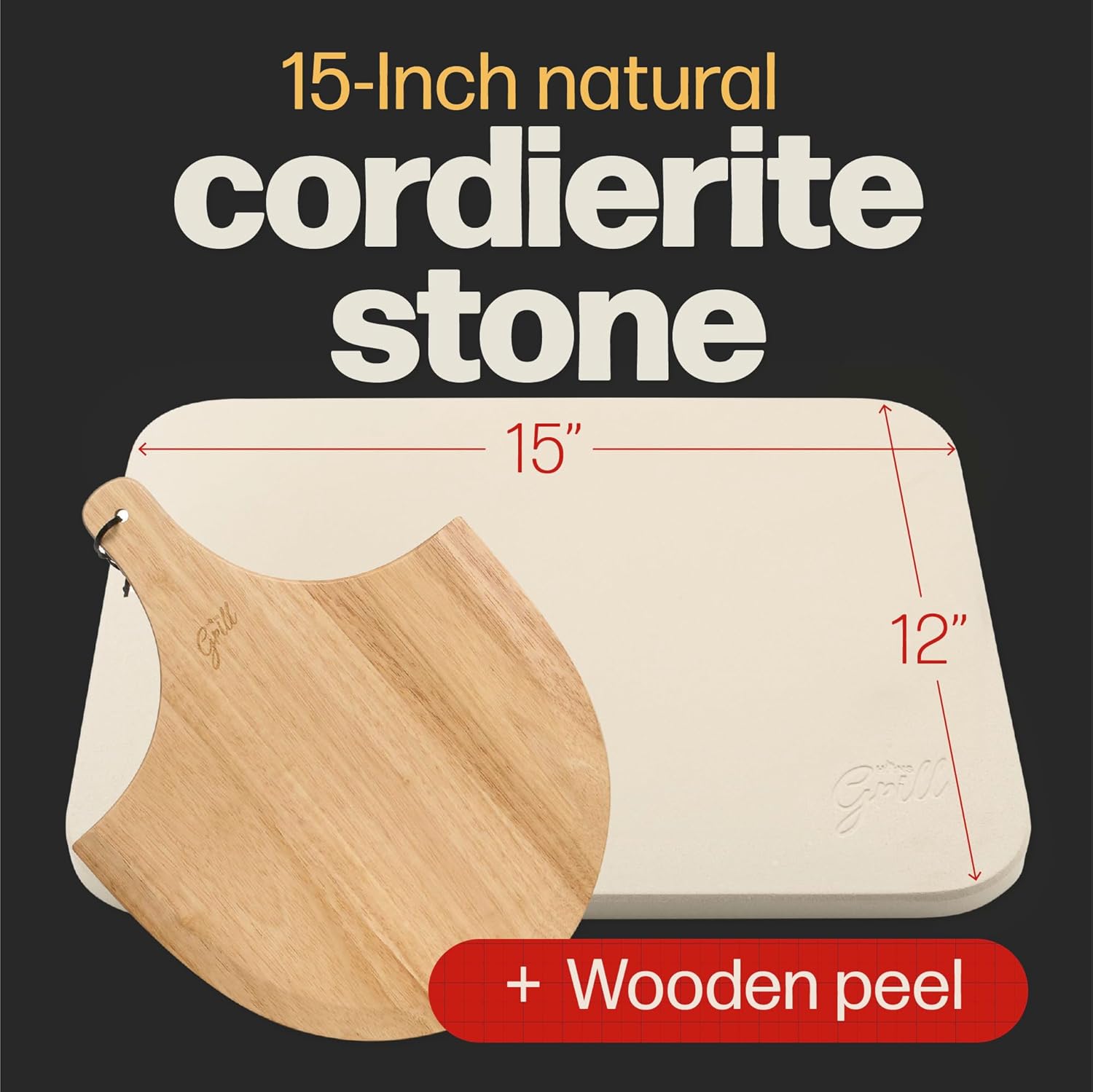
A pizza stone is exactly what it sounds like: a flat slab of heat-absorbing material you place inside an oven or outdoor cooker that mimics the floor of a wood-fired brick oven. When you slide raw dough onto a hot stone, it pulls moisture from the crust and delivers an intense burst of direct bottom heat—the difference between a limp, pale underside and a blistered, leopard-spotted crust with real structural crunch. The material most serious bakers default to is cordierite, a naturally occurring mineral ceramic prized for its ability to survive wild temperature swings without cracking. That cracking risk has a name—thermal shock—and understanding it is the whole game when you’re choosing a stone that will actually last.
This guide is written for buyers who already know they want a stone but are staring at a wall of options with confusing thickness specs and vague marketing claims. We’ll break down exactly how size and thickness interact with your cooking setup, why cordierite outperforms cheaper alternatives, and what the thermal shock risk really means in practice—so you can make a confident, trade-off-aware decision.
Why Cordierite and Not the Cheaper Stuff
Walk into any kitchen store and you’ll see pizza stones made from everything—plain terracotta (the reddish clay used for flower pots), cast iron, ceramic tile composites, and cordierite. Here’s how they actually differ.
Terracotta and basic ceramic stones are cheap and widely available, but they carry a high thermal shock risk. Thermal shock happens when a material heats or cools unevenly and fast: the outer surface expands while the interior hasn’t caught up yet, and the stone cracks. Terracotta’s porous, irregular structure makes it especially vulnerable. Wirecutter’s pizza stone coverage notes that lower-cost ceramic stones have a significantly shorter lifespan when subjected to the rapid heating cycles typical of wood-fired or solar ovens.
Cast iron baking surfaces solve the thermal shock problem entirely—iron doesn’t crack—but they conduct heat differently than stone. Cast iron delivers heat fast and aggressively, which suits some styles of pizza but tends to burn thin-crust bases before the top has set. It’s also heavy, slow to season evenly, and shows rust in outdoor or humid environments.
Cordierite occupies the sweet spot. It’s a magnesium iron aluminosilicate mineral (don’t worry about the chemistry) with an unusually low coefficient of thermal expansion—meaning it barely changes dimension as temperature swings. That physical property is why cordierite is used in catalytic converter substrates in cars and in kiln furniture in ceramics manufacturing. Serious Eats’ comprehensive pizza stone coverage consistently highlights cordierite as the material of choice for its combination of heat retention, moisture-wicking porosity, and long-term crack resistance under high-heat cycling.
The practical upshot: a cordierite stone used in an Ooni Karu 16 running at 900°F, then left to cool and reheated the next day, will survive that cycle reliably. A terracotta stone doing the same may crack on the third or fourth round.
One honest caveat: cordierite is not indestructible. Cold water on a screaming-hot cordierite stone will still cause thermal shock. The material’s advantage is a dramatically wider thermal envelope, not immunity. We’ll come back to this.
Sizing: Match the Stone to Your Setup, Not Your Ambitions
This is where buyers most commonly go wrong. The instinct is to buy the largest stone that fits your oven, but size interacts with airflow, preheating time, and your oven’s power output in ways that can actually hurt performance.
For home ovens (conventional or convection): Most residential ovens run 16–18 inches wide between the rack rails. A 14×16-inch cordierite stone is the practical maximum that still allows at least an inch of clearance on each side—that clearance matters because blocking airflow around the edges extends preheat time dramatically and creates uneven temperature zones. Bon Appétit’s guide to using pizza stones specifically flags this: a stone that nearly fills the oven cavity traps cool air below the stone and can actually lower the deck temperature at the cooking surface.
For Ooni and Gozney ovens: These compact outdoor ovens have smaller floor dimensions by design. The Ooni Karu 16 has a 16×14.5-inch stone deck. The Gozney Dome’s cordierite deck measures roughly 19.6 inches in diameter. Aftermarket replacement stones should match these dimensions precisely—going slightly smaller is acceptable; going larger creates binding risk as both the stone and the steel oven body expand under heat.
For Alfa Forni ovens: The Alfa Classico (wood-fired) and larger Alfa models have substantially bigger decks, often 27–32 inches across in the full-size versions. Here, multiple smaller stones tiled together are a practical option and are actually preferred by some operators because a cracked tile can be swapped individually.
For solar cookers: If you’re running a parabolic concentrator or a high-performance solar box cooker that reaches genuine baking temperatures (350°F+), sizing logic follows the same rules as conventional ovens—match stone to interior dimensions with clearance—but thermal shock risk is lower than in flame-fired setups because solar heat ramps more gradually. A 12×12-inch cordierite stone is typically sufficient for the GoSun or Solavore Sport-class cookers; larger parabolic setups can run the same 14×16-inch slabs used in home ovens.
By the Numbers
| Setup | Recommended Stone Size | Minimum Thickness |
|---|---|---|
| Home oven (standard) | 14×16 in | ¾ inch (19mm) |
| Ooni Karu 16 | 14.5×16 in (OEM match) | ⅝ inch (16mm) |
| Gozney Dome | 19–19.5 in round | ¾ inch (19mm) |
| Solar box cooker | 10×12 in | ½ inch (13mm) |
| Large wood-fired (Alfa Classico+) | Multi-tile or 20×20 in | 1 inch (25mm) |
Thickness: The Honest Trade-off Analysis
Thickness is the variable most buyers underweight, and it’s where the real performance trade-offs live.
Thicker stones (¾ inch and above) hold more thermal mass. Thermal mass is the stone’s ability to store heat energy and release it steadily rather than spiking and crashing. When you open a hot oven, slide in a room-temperature dough, and close the door, the stone’s thermal mass is what maintains the floor temperature through that cold-load interruption. A thin stone loses that stored heat quickly; a thick stone barely flinches. Food & Wine’s pizza stone buying guide notes that ¾-inch stones produce more consistent bottom crust results across consecutive bakes—relevant if you’re doing three or four pizzas back to back.
Thicker stones take longer to preheat. A 1-inch cordierite slab in a home oven needs 45–60 minutes at 500°F to reach full thermal equilibrium throughout its depth. A ½-inch stone reaches equilibrium in 20–25 minutes. If you’re baking one pizza on a Tuesday night, the half-inch stone is faster and more energy-efficient. If you’re running a dinner party or catering a glamping event with sequential bakes, the ¾-inch or 1-inch stone pays back that preheat time in crust consistency.
The thermal shock and thickness relationship is slightly counterintuitive. Thicker stones are more susceptible to cracking from thermal shock—not less—because the temperature differential between the hot surface and the still-cool interior is larger during rapid heating. This is why manufacturer instructions for thick cordierite stones universally emphasize low-and-slow preheating: start the oven at a lower temperature and bring it up gradually. Wirecutter’s stone testing notes that the majority of cracked-stone returns involve buyers who preheated at maximum temperature from a cold start. Cordierite handles it better than other materials, but patience is still the right protocol.
Thin stones (½ inch and under) are appropriate for solar box cookers, low-and-slow baking applications, and situations where weight is a genuine constraint. They’re not inferior—they’re just better suited to gentler, more consistent heat sources rather than the violent heat cycling of a wood-fired outdoor oven.
Thermal Shock in Practice: What Actually Cracks Stones
Thermal shock is the failure mode that ends most stones’ lives prematurely, and it’s almost always avoidable. Here’s what actually causes it in real-world use:
Water on a hot stone. This is the most common culprit. A spilled drink, a wet pizza peel, or—and this happens more than you’d think—someone running a hot stone under water to clean it. Never do this. Let the stone cool completely before any moisture contact.
Cold dough loaded directly from the refrigerator. Room-temperature dough is fine. A dough ball pulled straight from a 38°F fridge and slapped onto a 500°F stone can create a localized thermal shock at the contact point. Let dough come up to room temperature for 30–60 minutes before baking.
Sudden oven temperature changes. Using the broiler setting aggressively while the stone is in place, or cutting oven temperature dramatically mid-bake, creates rapid differential expansion. This is less of a risk with gradual preheating and stable bake temperatures.
Rapid cooling. Pulling a stone from a 500°F oven and setting it on a cold granite countertop is the same problem in reverse. Set it on a wooden rack or leave it in the oven to cool naturally.
Across aggregated reviews on major retail platforms—as summarized in Serious Eats’ stone buying coverage—the pattern is clear: cordierite stones that crack do so from owner handling errors, not from material failure. The stone itself is robust. The protocol around it is what requires care.
Decision Rules: If X, Then Y
Here’s the decision framework, stated plainly:
If you’re baking in a home oven and doing 1–2 pizzas at a time: A 14×16-inch, ¾-inch cordierite stone is your buy. It fits most oven cavities with clearance, preheats in 45 minutes, and handles home-use thermal cycling without drama.
If you’re running an Ooni Karu 16, Gozney Dome, or Alfa Classico: Match the OEM stone dimensions. Aftermarket cordierite at the same spec is a legitimate option and often costs less than OEM replacements; just confirm the thickness matches (Ooni and Gozney run ⅝–¾ inch). Don’t upsize.
If you’re doing high-volume consecutive baking—catering, glamping operations, dinner parties: Go to 1-inch cordierite and accept the longer preheat. The thermal mass investment pays off after bake three and four. Budget 60 minutes of preheat time into your service window.
If you’re using a solar box or panel cooker: A ½-inch, 10×12-inch cordierite slab is sufficient and lighter to transport. Thermal shock risk is low given solar heat’s gentler ramp rate.
If you live in a climate with limited solar cooking windows (Pacific Northwest, upper Midwest winters): Stone choice becomes secondary to oven choice—but a round cordierite stone sized to your indoor oven keeps your technique sharp year-round when outdoor solar cooking isn’t viable.
If you’re buying for a permanent outdoor kitchen build: Treat the stone as a consumable with a 2–4 year service life under heavy use. Factor replacement cost into the project budget from the start rather than treating the first purchase as a one-time expense.
The stone is not the glamorous part of the pizza setup. It’s the part that quietly determines whether your crust is good or great—and whether your investment lasts one season or ten. Get the sizing and thickness right for your actual setup, treat it with the thermal care cordierite deserves, and it becomes one of the most reliable pieces of kit in your outdoor kitchen.